


Tequila is a distilled spirit made from cooked Blue Weber agave, and its production follows a fixed sequence: harvest, cook, extract, ferment, distill and, for some categories, age before bottling. Every step is governed by NOM-006-SCFI-2012 and monitored by the Consejo Regulador del Tequila (CRT), which sets ABV limits, aging minimums, and the geographic boundaries where the agave must grow. Traditional methods like hornos and tahona stone crushing slow the process down but build flavor complexity that industrial shortcuts often sacrifice for speed.
- Traditional cooking methods like hornos and tahona produce more complex flavors, but slow down production compared to industrial shortcuts like autoclaves and diffusers.
- Harvesting by jimadores at optimal maturity, between 7 to 10 years, ensures higher sugar content necessary for efficient fermentation and quality tequila.
- Distillation is limited by law to 55% ABV, with most finished spirits around 40%, and traditional pot stills contribute to smoother, more flavorful tequila.
- Aging classifications such as reposado and añejo require minimum periods of two months and one year respectively, affecting final flavor profiles and barrel influence.
- Authentic craft tequila features 100% Blue Weber agave, slow cooking, hand-harvesting, small-batch fermentation, and pot-still distillation, all of which influence flavor and quality.
Table of Contents
- The Tequila Production Process: An Overview
- Agave and Cultivation: Why Blue Weber Matters
- Harvesting: The Jimador’s Role in Tequila Making
- How Cooking Converts Agave Into Fermentable Sugar
- Extraction: How Producers Separate Juice From Fiber
- Fermentation: Turning Agave Juice Into Alcohol
- Distillation Steps and Legal ABV Limits
- Maturation and Classification: What Reposado and Añejo Actually Mean
- Blending, Bottling, and the CRT’s Final Checks
- Traditional Vs Modern Choices: Reading Craft Signals Honestly
- What Traditional Methods Preserve
- Taste the Traditional Process in Every Bottle
- Where to Verify the Facts in This Guide
- Sources
- FAQ
The Tequila Production Process: An Overview
Producing tequila takes years before a single drop reaches a still. The agave itself needs roughly 5 to 12 years to mature in the field, and once harvested, the liquid-to-bottle portion of the process typically runs from a few weeks for blanco up to multiple years for extra añejo. That timeline splits into six distinct stages, each with a traditional method and a faster industrial alternative.
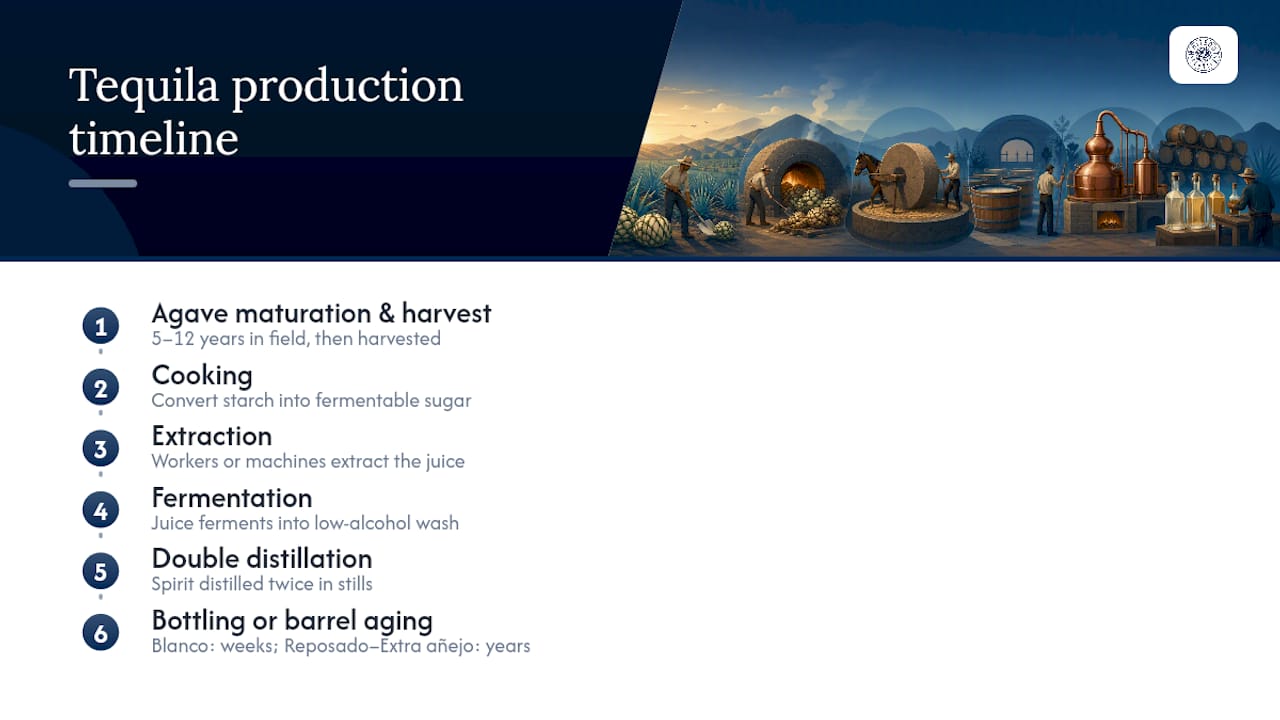
The core sequence rarely changes: jimadores harvest mature piñas, the agave gets cooked to convert starch into fermentable sugar, workers or machines extract the juice, that juice ferments into a low-alcohol wash, distillers run it through a still twice, and the resulting spirit either gets bottled immediately as blanco or rests in oak barrels for classification as reposado, añejo, or extra añejo. What separates one producer’s tequila from another almost always comes down to how each of those steps gets executed, not whether they happen at all.
Agave and Cultivation: Why Blue Weber Matters
Only one agave species can legally become tequila: Agave tequilana Weber, commonly called Blue Weber or blue agave. No substitutions, no blends with other species. The plant needs 5 to 12 years to reach harvest maturity, though most producers target the 7 to 10 year window when sugar concentration peaks without the plant beginning to flower and burn through its stored carbohydrates.
Farmers judge readiness by a mix of visual cues and lab testing:
- Leaf posture: mature plants develop a slightly drooping, waxy leaf structure that signals slowed growth.
- Brix readings: field technicians test sap sugar content directly, looking for concentrations that support efficient fermentation.
- Piña weight: a fully mature piña commonly weighs between 80 and 200 pounds, though size varies by soil and altitude.
- Region: highland agave (grown around Los Altos) tends to produce sweeter, more floral profiles, while lowland agave near the town of Tequila often yields earthier, more vegetal notes.
Juice yield from a single piña swings widely based on size and which extraction method a distillery uses, which is why two producers working the same field can end up with noticeably different output per ton.
Harvesting: The Jimador’s Role in Tequila Making
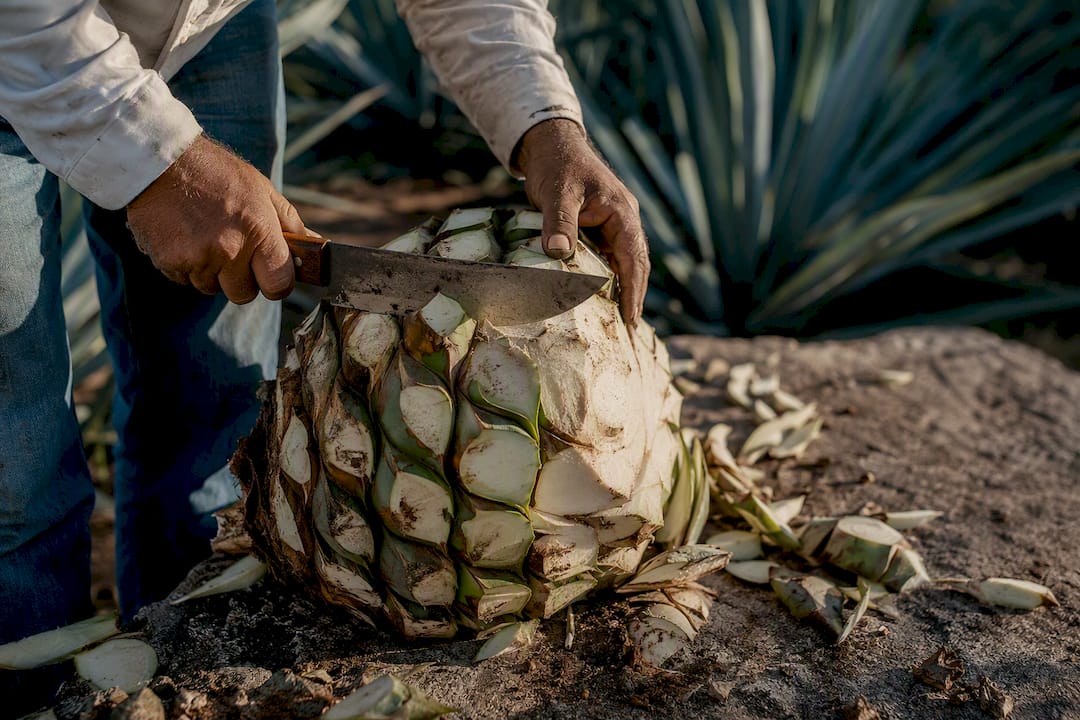
Jima is the harvest, and a jimador is the skilled worker who performs it. This is not casual farm labor. A jimador reads each plant and decides, almost entirely by eye and feel, whether it’s ready to come out of the ground.
The tool of the trade is the coa, a long-handled blade with a round, flat head that a jimador swings with practiced precision to strip away the spiky leaves and free the piña, the heart of the plant, from its roots. A skilled jimador can process hundreds of plants in a single day.
- Harvest too early, and the piña lacks the sugar concentration needed for efficient fermentation.
- Harvest too late, and the plant may have already sent energy into a flowering stalk called a quiote, robbing the piña of stored sugar.
- Once cut, piñas get trimmed of any remaining leaf stubs and hauled to the fábrica quickly, since delays before cooking can lead to sugar degradation and unwanted fermentation starting prematurely.
Pro Tip: When a label claims “hand-harvested” agave, that’s a real production detail, not marketing fluff. It means a jimador individually assessed each plant rather than machine-harvesting a field on a schedule, which tends to produce more consistent sugar content at the cooking stage.
How Cooking Converts Agave Into Fermentable Sugar
Raw agave is packed with inulin, a complex carbohydrate that yeast cannot ferment directly. Cooking breaks that inulin down into simple, fermentable sugars through a process called hydrolysis, and how a distillery applies heat here shapes the final flavor more than almost any other single decision.
- Hornos: traditional masonry ovens that steam-bake piñas slowly, typically running 24 to 72 hours or longer, including a lengthy cooling period. The slow heat caramelizes sugars gently and produces the roasted, earthy, complex notes associated with old-school tequila.
- Autoclaves: pressurized steel chambers that cut cooking time dramatically, often to somewhere in the 6 to 12 hour range. Faster and more energy-efficient, but the flavor tends to read cleaner and less layered.
- Diffusers: continuous-extraction systems that combine shredding and chemical or enzymatic hydrolysis, often applied to raw, uncooked agave fiber. Yield is high and throughput is fast, but critics argue this method strips out the roasted character that hornos develop.
Enzymatic or chemical hydrolysis lets producers skip traditional cooking almost entirely, which raises real questions when a bottle markets itself as artisanal. A tequila that used a diffuser and enzyme bath is legally identical under NOM to one cooked for three days in a horno, but the two rarely taste alike.
Extraction: How Producers Separate Juice From Fiber
Once cooked agave comes out soft and caramelized, someone has to press the sugar-rich juice out of the fibrous pulp. The method chosen here determines how much solid material ends up in the fermentation tank alongside the liquid.
- Tahona: a massive volcanic stone wheel that crushes cooked piñas in a circular pit, used by only a handful of producers today. Yields are lower, but the process leaves more fiber and aromatic compounds in the must.
- Roller mills: a train of mechanical rollers that squeeze juice from the cooked agave, the industry standard for balancing yield against retained character.
- Diffuser and shredder systems: mechanically shred agave (sometimes before cooking) and extract sugar with high efficiency, maximizing recovery but producing a cleaner must with fewer solids.
- Bagazo reuse: some craft distillers keep a portion of the leftover fiber, or bagazo, in the fermentation tank to trap additional aromatics, a technique that shapes both texture and fermentation dynamics.
Extraction choice directly affects must clarity, and a cloudier, fiber-rich must generally ferments into a spirit with more textural weight and rustic character.
Fermentation: Turning Agave Juice Into Alcohol
The extracted juice, called mosto or must, becomes alcohol through fermentation, and this stage is where a distiller’s yeast and temperature choices leave a lasting fingerprint on the final aroma. Producers typically adjust sugar concentration, pH, and nutrient levels in the mosto before introducing yeast, since an unbalanced must ferments unevenly or stalls.
- Wild fermentation: relying on ambient yeast naturally present on the agave and in the fábrica, which builds unpredictable but often complex flavor profiles unique to a specific distillery.
- Cultivated yeast: inoculating with commercial or proprietary Saccharomyces strains for predictable, repeatable fermentation that large producers rely on for consistency.
Pro Tip: Foam management matters more than most drinkers realize. Excess foam during vigorous fermentation can carry aromatics out of the tank, so distillers use mechanical defoamers or adjust calcium levels to keep the process stable without stripping desirable esters.
Distillation Steps and Legal ABV Limits
Distillation happens in two stages, and this is the point where the fermented wash, sitting at roughly 4 to 9% alcohol, becomes an actual spirit.
- First distillation (ordinario): the still separates alcohol from water and solids, typically producing a distillate around 20 to 30% ABV known as ordinario.
- Cuts: distillers discard the “heads” (early, harsh volatile compounds) and “tails” (late, oily, heavy compounds), keeping only the “heart” of the run for the next stage. Heads and tails are often recycled into a future batch rather than wasted.
- Second distillation: the ordinario runs through the still again, refining it into the clear spirit that will become tequila, with distillers again making cuts to isolate the cleanest, most balanced portion.
Still construction changes the outcome noticeably. Traditional copper pot stills impart smoothness and help scrub off sulfur compounds, stainless steel stills with copper contact points offer a middle ground, and column stills favor continuous, high-volume production at the expense of some textural complexity.
NOM-006 caps distillation strength at 55% ABV maximum, and finished bottles typically land somewhere in the 35% to 55% ABV range after dilution, with 40% being the most common commercial proof.
Maturation and Classification: What Reposado and Añejo Actually Mean
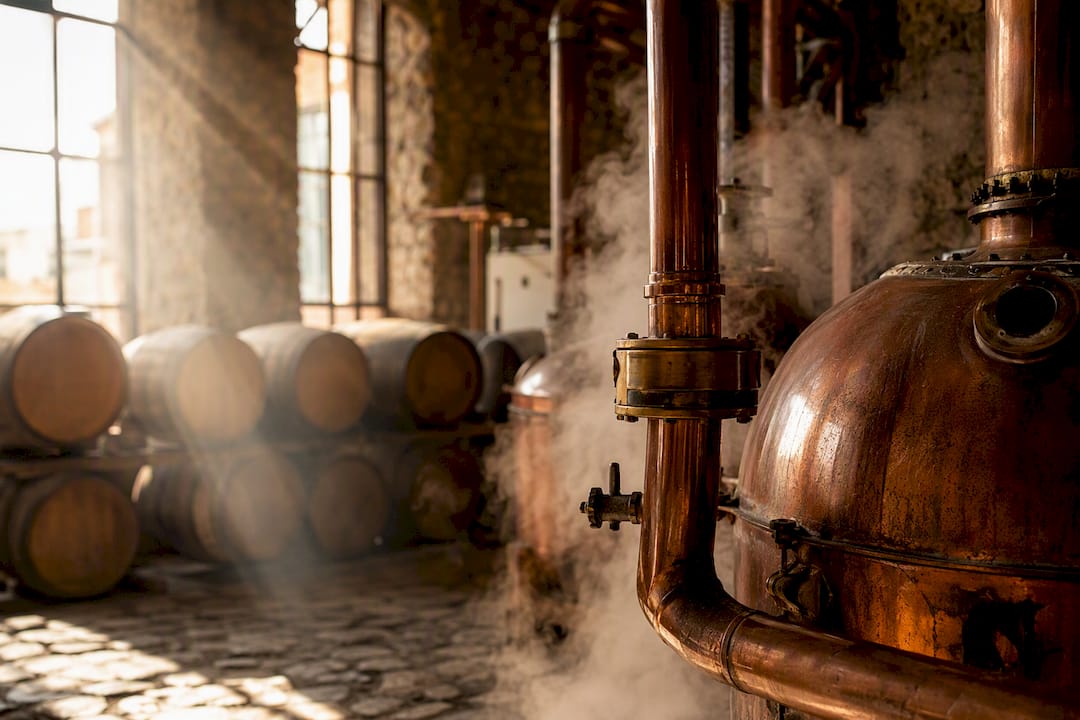
Aging is optional for tequila, but once a producer chooses to age it, strict minimums kick in that determine what the label can legally say — learn more about barrel influence in Types of Spanish Wines: Regions, Grapes, and Pairings. Barrel size, oak type, and even regional climate all influence how quickly a spirit picks up color and flavor from wood.
| Classification | Minimum aging | Typical barrel character |
|---|---|---|
| Blanco | None (bottled shortly after distillation) | No wood contact |
| Reposado | At least 2 months | Light oak influence, subtle vanilla and caramel |
| Añejo | At least 1 year | Deeper oak character, more caramelized notes |
| Extra añejo | At least 3 years | Rich, whiskey-adjacent complexity |
- New oak imparts stronger vanilla and spice notes, while used ex-bourbon barrels contribute subtler caramel and coconut character.
- Heavier toast or char levels intensify smoke and roasted notes but can overpower delicate agave character if aging runs long.
- Warmer storage climates accelerate maturation, which is part of why some añejo tequilas taste more developed than a bourbon aged for the same span in a cooler warehouse.
Most commercial tequila gets blended across multiple barrels before bottling to smooth out batch variation, which is why a brand’s reposado tastes consistent bottle after bottle even though no two barrels age identically. Reading age statements on a tequila’s flavor profile tells you far more about what’s in the glass than color alone, since some producers add caramel coloring to make a young tequila look older than it is.
Blending, Bottling, and the CRT’s Final Checks
- 100% agave: must be distilled entirely from Blue Weber sugars, with the label stating “100% agave” or “100% Blue Agave” explicitly.
- Mixto: can contain as little as 51% agave sugar, with the rest coming from other fermentable sugars, and often carries permitted additives like caramel color or glycerin for mouthfeel.
- Additive-free craft tequila skips those permitted extras entirely, relying on the agave and production method alone for color and flavor.
- Filtration removes sediment and can strip some texture; producers dilute distillate with water to reach bottling proof, and water mineral content genuinely affects the final mouthfeel.
- The CRT inspects production facilities at multiple stages and verifies the NOM number printed on every legitimate bottle, tracing it back to a specific certified distillery.
Traditional Vs Modern Choices: Reading Craft Signals Honestly
Some production claims are objective and checkable. A NOM number and CRT certification are printed facts you can verify against the regulator’s own registry. Others, like “artisan” or “handcrafted,” carry no legal definition and mean whatever a marketing team decides.
Genuine craft signals cluster together rather than standing alone: 100% Blue Weber agave, slow-cooked hornos, hand-harvested piñas, small-batch fermentation, and pot-still distillation. One of those claims alone means little. All five together usually means something.
Pro Tip: Before trusting a “handcrafted” label, check whether the brand states its cooking method and still type outright. Vague language paired with specific NOM/CRT details is a stronger signal than confident marketing copy with no technical specifics at all.
What Traditional Methods Preserve
Hornos, tahona, and wild fermentation survive not because they’re efficient but because they carry flavor and cultural memory that faster methods can’t fully replicate. Agave takes most of a decade to mature, which makes responsible field stewardship, not just clever distilling, the real foundation of good tequila. Read more production breakdowns on the Whiteout Tequila blog.
— Whiteout Tequila Team
Taste the Traditional Process in Every Bottle
Everything covered above, the slow cooking, the careful cuts, the additive-free formulation, is exactly what Whiteout Tequila builds into its 100% Blue Weber blanco. No mixto shortcuts, no caramel coloring standing in for real barrel time, just small-batch production that treats the agave itself as the main event.
The blanco has already picked up a gold medal recognition, which matters more once you understand how many corners a producer can legally cut before a spirit still gets to call itself tequila. If you want to see what additive-free actually tastes like, shop the collection and pour it next to whatever mixto is currently in your cabinet. For sipping the right way, the barware and glassware rounds out the setup.
Where to Verify the Facts in This Guide
The claims above trace back to a small set of primary sources worth bookmarking if you want to check label claims yourself or go deeper into the regulatory side.
- The CRT’s official tequila page lays out the legal definition of tequila, the certification process, and Designation of Origin protections that limit where the agave can legally grow.
- NOM-006-SCFI-2012 sets the technical standard, including the 55% ABV distillation ceiling and the aging minimums for each classification.
- A scientific review of tequila production on PubMed covers the biochemistry behind hydrolysis, fermentation, and distillation in more technical depth.
- The tequilana.org production breakdown and Difford’s Guide both walk through cooking and extraction method trade-offs with practical detail on timing and flavor outcomes.
Sources
- Tequila production - PubMed
- Our Tequila – Consejo Regulador del Tequila – Autenticidad y Calidad Certificada
- How Tequila Is Made: Agave, Cooking, Fermentation - Difford’s Guide
FAQ
Why Can’t Tequila Be Made in the United States?
Tequila carries a Designation of Origin under Mexican law, meaning it can legally only be produced in specific regions of Mexico, primarily Jalisco and parts of four neighboring states, under CRT oversight. A distiller in the US could grow Blue Weber agave and follow the same process, but the resulting spirit legally couldn’t be labeled tequila.
Is Tequila Bad for You Compared to Other Spirits?
Tequila isn’t uniquely unhealthy compared to other distilled spirits; alcohol’s health effects come mostly from ethanol content and quantity consumed, not the source ingredient.
What Is the Best Tequila in the World?
There’s no single universally agreed “best” tequila since quality is largely subjective and competition wins vary by year and category.
How Many Bottles of Tequila Come From One Agave Plant?
Yield varies significantly based on piña size and extraction method, since a larger, riper piña processed with an efficient mill recovers more fermentable sugar than a smaller one crushed by tahona. There’s no fixed bottle count per plant that applies across all producers and methods.
